
Keep the mud on the site
Silt Fence & Perimeter Sediment Control in Atlanta, GA
Silt fence, inlet protection and upkeep that keeps red clay out of streets, drains and creeks.
- We measure on site and hand you a written quote
- Fescue or bermuda picked for how much sun your yard gets and the month we spray
- Seeding, slope cover and silt fence from one call
Catching Sediment Before It Leaves
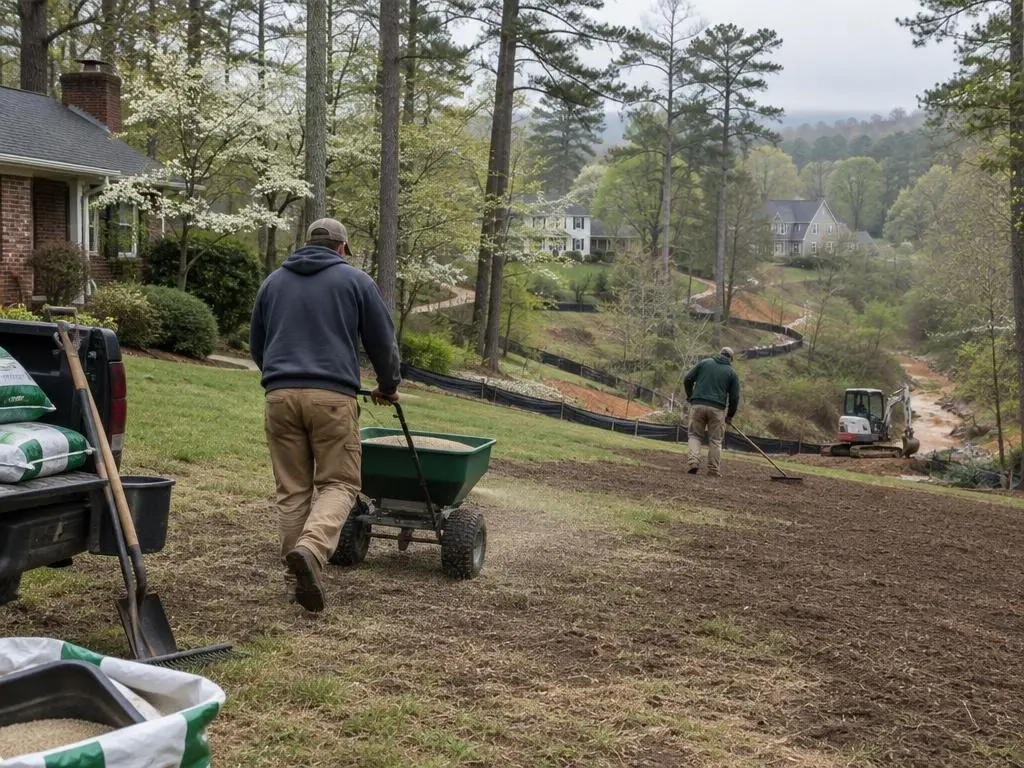
Silt fence and perimeter sediment control in Atlanta is the first line of erosion work on almost every construction site and on plenty of home projects. The fence itself is a woven geotextile, its bottom edge buried in a narrow trench and its face held upright by stakes along the low edges of a disturbed area. Water ponds behind it and drops its sediment before seeping through. We are silt fence contractors for builders, site contractors and homeowners doing additions, pools, grading or drainage work, and we install inlet protection, maintain fences through the job and remove them when the ground is covered with grass.
Why sediment control matters so much here
Red Piedmont clay turns runoff orange, and it does not take much. Atlanta averages about 50 inches of rain a year with every month over 3 inches, so a disturbed lot sees regular storms whatever the season. Georgia's Erosion and Sedimentation Act requires that, to the extent necessary, sediment in runoff be trapped by sediment basins, silt traps or similar measures until the disturbed area is stabilized. Plans must include facilities to retain sediment on site. A discharge from a site where best management practices were not properly designed, installed and maintained is a violation for each day it pushes the turbidity of receiving waters more than 25 NTU above normal in warm water streams, or 10 NTU in trout waters.
Installation that works
Most silt fence that fails was installed wrong. The bottom of the fabric needs to sit down in a trench on the uphill side, not just pinned at the surface, or water runs underneath. Stakes go on the downhill side. The fence should follow the contour, not run straight down a slope where it acts as a channel, and the ends should turn uphill so water does not wrap around them. In high-flow spots or where the fence holds a lot of sediment, a wire-backed or stabilized fence lasts longer. Silt fence is meant to handle spread-out sheet flow, not a concentrated stream, so in ditches and swales we use other measures.
Inlet protection
Storm drain inlets carry runoff straight to creeks, and the City of Atlanta's watershed department points out that stormwater runoff picks up sediment along with litter, oil and fertilizer as it crosses the ground. Inlet protection catches that sediment at the drain. Depending on the inlet and traffic, we use silt fence barriers around yard and area inlets, gravel and mesh, sandbags or devices set below the grate in curb inlets. Every type needs cleaning after storms to keep working.
Stream and lake buffers
Georgia law sets a 25 foot buffer along the banks of state waters, measured from where vegetation has been wrested by normal stream flow, and a 50 foot buffer along trout streams. No land disturbance is allowed inside a buffer, and it stays in natural vegetation until all land-disturbing activity on the site is finished. Many lots in the metro back up to creeks, ponds or lakes, and a properly placed silt fence line marks and protects that edge as well as trapping sediment.
Maintenance and removal
A silt fence is only as good as its last inspection. Sediment piled halfway up the fabric, sagging sections, torn spots and undercut ends all need fixing, especially after heavy rain. We can maintain fences through a project and pull them once permanent vegetation has covered the area. Removing a fence early is one of the most common ways a site ends up with mud in the street.
Common silt fence jobs
- Perimeter fence on new house lots and additions
- Fence along creek and lake buffers
- Inlet protection on curb and yard inlets
- Repairs after storms and before inspections
- Removal and seeding of the fence line at project end
Sediment Control Services
Installed, maintained and removed, with seeding to finish the job.
Standard silt fence installation
Trenched-in geotextile fence on stakes along the low edges of disturbed ground.
Wire-backed or stabilized fence
Reinforced fence for longer runs, heavier sediment loads or spots that take more flow.
Curb and yard inlet protection
Barriers, gravel and mesh, sandbags or under-grate devices at storm drains.
Buffer-line fencing
Fence placed to mark and protect stream and lake buffers on lots near water.
Inspection and repair
Cleaning out sediment, resetting sagging sections and fixing undercut or torn fabric.
Removal and fence-line seeding
Pulling the fence once grass is established and seeding the strip it leaves.
Silt Fence and Inlet Protection Rates
| Item | Rate (a state highway 2025 cost list) |
|---|---|
| Unstabilized silt fence, per 100 linear ft | $378 |
| Stabilized silt fence, per 100 linear ft | $748 |
| Silt fence inlet barrier, each | $102 |
| Sandbag inlet protection, each | $141 |
| Gravel and mesh inlet protection, each | $172 |
These are installed unit rates from a state highway 2025 cost list, shown as a reference. Length, ground conditions and maintenance needs set your price. Use as a guide. Our written quote spells out the final cost.
How a Fence Goes In
1. Walk the low edges
We find where water will leave the disturbed area and mark the fence line along the contour.
2. Trench and set
Fabric is buried on the uphill side and stakes are driven on the downhill side.
3. Protect the inlets
Nearby curb and yard inlets get protection matched to their type.
4. Maintain
After storms, sediment is removed and damaged sections are repaired.
5. Remove and seed
Once grass covers the area, the fence comes out and the line is seeded.
Why Choose Us for Silt Fence & Perimeter Sediment Control
Buried, not pinned
Every fence is trenched in so water cannot run under it.
Seeding in-house
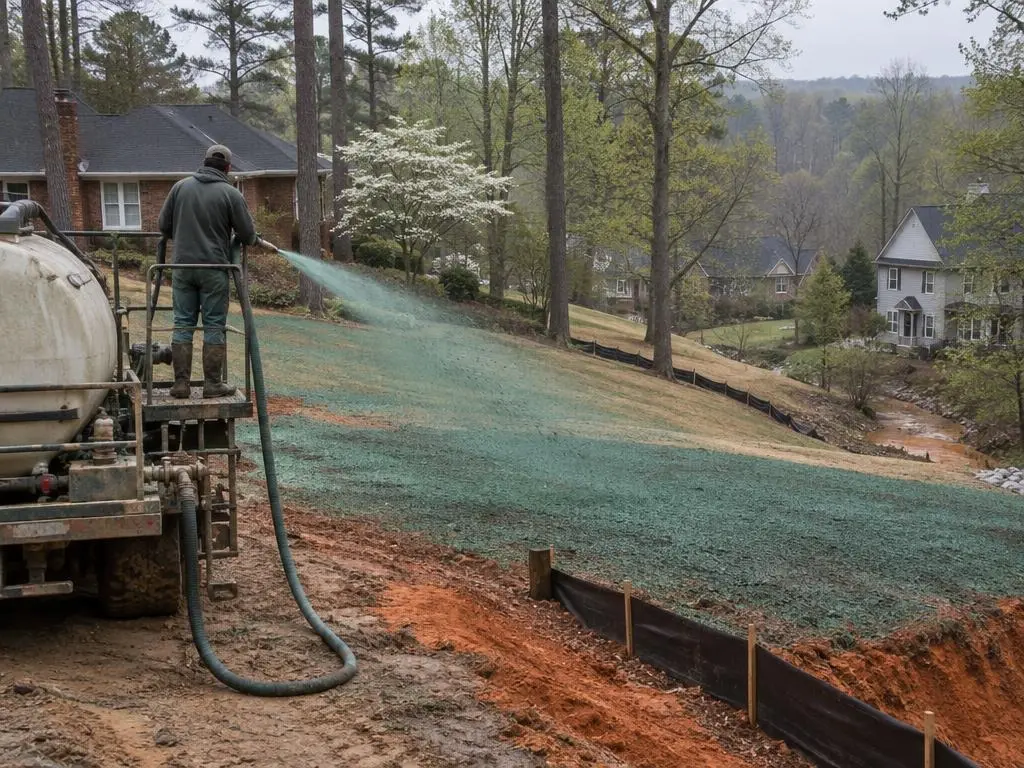
The same call that installs the fence can stabilize the ground and remove it later.
Upkeep available
We can check and repair fences through a project, not just install and leave.
Silt Fence & Perimeter Sediment Control Questions
Does my home addition or pool project in Atlanta need silt fence?
Any project that exposes soil where runoff could reach a street, drain or creek should have sediment control, and permitted work in the metro usually requires it on the plan. Your permit or builder will say what is required; we install to that.
Why does silt fence fail?
The most common reasons are fabric that was not buried, so water runs underneath; fence running downhill instead of along the contour; and sediment left to build up until the fence sags or tears. Installed and maintained correctly, it works well for sheet flow.
When can the silt fence come down?
When the area it protects is covered with established vegetation, not just freshly seeded. Taking it down too early is one of the easiest ways to get mud in the street after the next storm.
What is inlet protection?
It is a barrier or filter at a storm drain inlet that catches sediment before it enters the pipe. Types include silt fence barriers, gravel and mesh, sandbags, and devices set under the grate.
Silt Fence & Perimeter Sediment Control Service Areas
- Hydroseeding in Atlanta, GA
- Hydroseeding in Sandy Springs, GA
- Hydroseeding in Roswell, GA
- Hydroseeding in Alpharetta, GA
- Hydroseeding in Johns Creek, GA
- Hydroseeding in Milton, GA
- Hydroseeding in Marietta, GA
- Hydroseeding in Kennesaw, GA
- Hydroseeding in Acworth, GA
- Hydroseeding in Woodstock, GA
- Hydroseeding in Canton, GA
- Hydroseeding in Cumming, GA
- Hydroseeding in Suwanee, GA
- Hydroseeding in Buford, GA
- Hydroseeding in Lawrenceville, GA
- Hydroseeding in Snellville, GA
- Hydroseeding in Conyers, GA
- Hydroseeding in McDonough, GA
- Hydroseeding in Peachtree City, GA
- Hydroseeding in Fayetteville, GA
- Hydroseeding in Newnan, GA
- Hydroseeding in Douglasville, GA
- Hydroseeding in Dallas, GA
- Hydroseeding in Powder Springs, GA
Get a Silt Fence & Perimeter Sediment Control Estimate
Tell us the lot size and where water leaves the site, and we will quote the fence line.