
New lawns for homes
Residential Hydroseeding in Atlanta, GA
A full hydroseed lawn on prepared ground, seeded with the grass your sun and shade can support.
- We measure on site and hand you a written quote
- Fescue or bermuda picked for how much sun your yard gets and the month we spray
- Seeding, slope cover and silt fence from one call
A New Lawn Without Rolling Out Sod
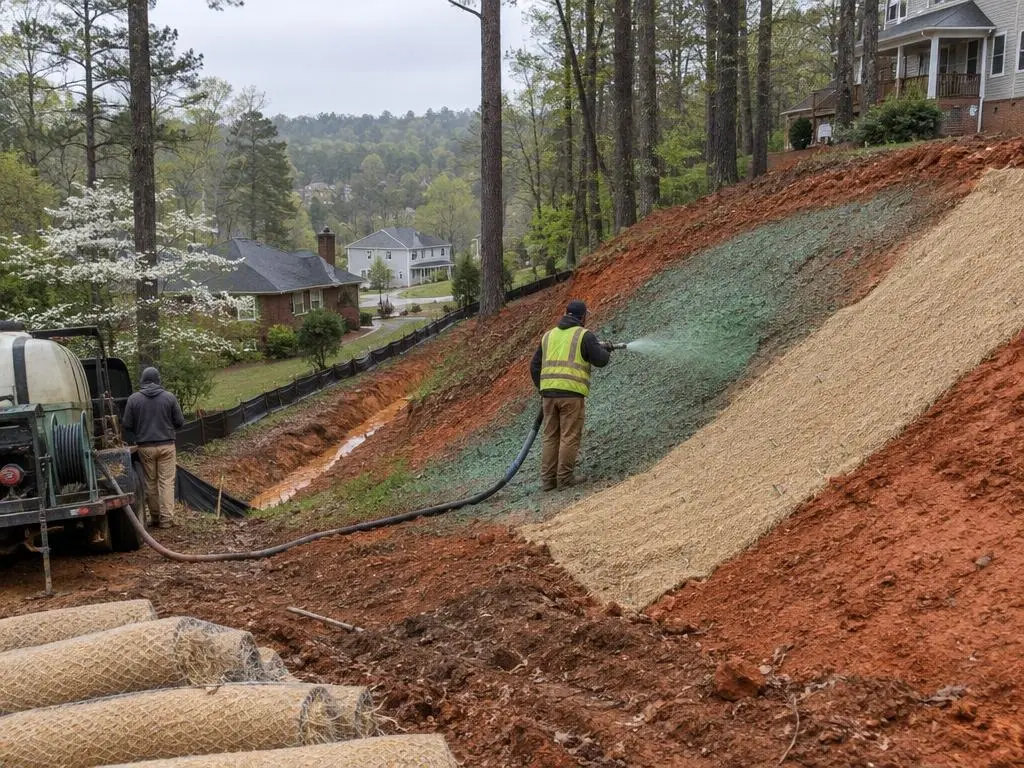
Residential hydroseeding in Atlanta is how most homeowners get a full new lawn for a fraction of what sod costs. We spray a slurry of seed, mulch, fertilizer and tackifier onto ground that has already been loosened and graded, and that mulch layer pins the seed down and keeps it damp while it sprouts. It is the right call after a new build, a septic or sewer repair, a drainage project, or when an old lawn has thinned out so far that patching no longer makes sense. If your yard is bare red clay, has more weeds than grass, or keeps washing into the street, a hydroseed lawn is worth a look.
What the ground under your yard is like
Most metro Atlanta yards sit on Piedmont soil like the Cecil series: a thin cap of brown sandy loam, only inches deep, resting on red kaolinite clay. On older lots the brown layer is often thin or gone, because erosion stripped the topsoil from much of the Piedmont over generations of farming. On new lots, grading usually scrapes it away or buries it under fill. Kaolinite clay also has little ability to recover once heavy equipment has packed it down. So a hydroseed lawn here starts with soil work: loosening compacted clay, adding topsoil where needed, and adding lime, because Cecil soils are naturally strongly acidic.
Fescue, bermudagrass or both
The grass choice comes from your light, not from a catalog. Atlanta's tree canopy is among the densest of any major city, and many yards get only a few hours of direct sun. Tall fescue is the most heat tolerant of the cool-season grasses, roots deeper than the others and is well adapted to the transition zone that includes Georgia, so it is our usual pick for partly shaded yards. Bermudagrass needs full sun, spreads by runners into a dense mat, and handles heat and drought very well, but dense shade suppresses it and it turns light brown when dormant. On many lots we seed fescue in the shaded front and bermudagrass in the open back.
When to seed
For fescue, University of Tennessee Extension puts the ideal window at late August to mid-October, and Atlanta's September and October weather fits that well. Bermudagrass wants warm soil: it starts active growth above about 59 degrees, and the same Extension guidance puts warm-season planting between May 1 and June 30. Outside those windows we can still cover bare soil with hydromulch and a temporary cover so it does not erode, then come back to seed the permanent lawn in season.
Hydroseeding cost and what moves it
HomeGuide's figures for a hydroseed lawn run from $0.12 up to $0.35 a square foot; a 5,000-square-foot yard lands around $1,000 to $1,750. Most hydroseeding companies also set a floor on small jobs, typically $300 to $500 or more. The price on your quote moves with soil prep (how much topsoil, lime and loosening the lot needs), access for the truck and hose, slope, and the seed mix. HomeGuide says steep slopes can add $0.05 to $0.10 per square foot. We list prep, seed and any slope work as separate lines.
Caring for a new hydroseed lawn
The first three weeks decide most of the result. The seedbed has to stay damp, which usually means light, frequent watering rather than one long soak, and Iowa State Extension notes up to four light waterings a day may be needed when it is hot and windy. HomeGuide says the first sprouts show in 5 to 7 days when weather and moisture cooperate, and the mower can usually come out 4 to 6 weeks after spraying. We leave written instructions; until the new grass can take it, the area stays clear of kids, dogs and mowing.
Signs your yard is a candidate
- Bare or nearly bare soil after construction, grading or utility work
- Red clay showing through a thin lawn, or ruts where water runs
- More weeds than turf across most of the yard
- A slope or side yard too large or awkward for sod at a sensible price
What a Residential Job Includes
Each piece below is quoted on its own line, so you can see what your yard needs.
Clay loosening and debris removal
Breaking up packed subsoil and pulling out rocks, roots and construction scraps before seeding.
Topsoil and lime
Adding topsoil where the brown layer is missing and lime to correct strongly acid Piedmont soil.
Fine grade
A smooth final grade that sheds water away from the foundation and out of low spots.
Shade-tolerant fescue lawns
Tall fescue blends for yards under oaks and pines, seeded in the late summer and fall window.
Full-sun bermudagrass lawns
Bermudagrass for open lots, seeded in late spring and early summer when soil is warm.
Split sun and shade plans
Different mixes in different zones of the same yard, so each area gets grass that can live there.
Watering and first-mow guidance
Written care steps for the first six weeks, matched to the season you seeded in.
Residential Hydroseeding Cost Ranges
| Lawn size or item | Published range |
|---|---|
| Per square foot, hydroseed lawn (HomeGuide) | $0.12 to $0.35 |
| Small lawn near 2,000 sq ft (HomeGuide) | $500 to $700 |
| Typical yard near 5,000 sq ft (HomeGuide) | $1,000 to $1,750 |
| Quarter-acre lot (HomeGuide) | $1,900 to $2,800 |
| Minimum job fee, most companies (HomeGuide) | $300 to $500 or more |
| Extra for steep ground, each sq ft (HomeGuide) | $0.05 to $0.10 |
| Sod installation for comparison (HomeGuide) | $1 to $4 per sq ft |
These are national published ranges, not our price list. Prep, slope, access and seed mix change every lawn. Use as a guide. Our written quote spells out the final cost.
From Bare Dirt to First Mow
1. Walk and measure
We measure the area, note shade through the day, and check slope, drainage and water access.
2. Prepare the soil
Debris out, clay loosened, topsoil and lime added where the yard needs them, then a fine grade.
3. Spray the lawn
One wet, even coat carries the seed, mulch, fertilizer and tackifier together, tinted so you can see coverage.
4. Water and wait
You keep the seedbed damp; sprouts usually show within about a week in good weather.
5. First mow
Around 4 to 6 weeks out, once the grass is tall enough, the lawn gets its first cut.
Why Choose Us for Residential Hydroseeding
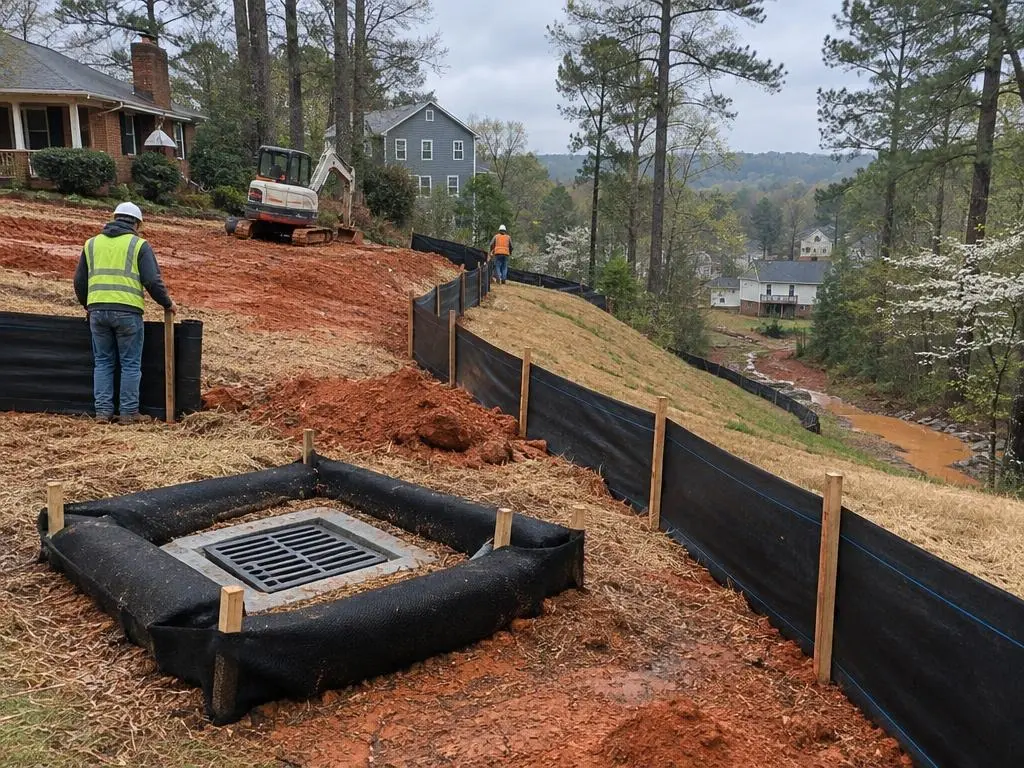
Prep is in the quote
We price the soil work your clay actually needs instead of spraying over it and hoping.
Right grass for the light
We will not sell you bermudagrass for a yard under a full oak canopy.
Seasonal honesty
Out of season, we offer erosion cover now and the permanent lawn when the window opens.
Residential Hydroseeding Questions
What does hydroseeding cost for an Atlanta yard?
HomeGuide's national figures run from $0.12 up to $0.35 a square foot, with a 5,000-square-foot yard around $1,000 to $1,750, and most companies have a small-job minimum of roughly $300 to $500 or higher. Red clay lots that need topsoil, lime and loosening cost more to prepare than a yard with good soil. We quote on site once we measure.
How soon will a hydroseed lawn look green?
The colored mulch makes the yard look green right away, but that is dye. With warm soil and steady moisture, grass usually sprouts in about 5 to 7 days, then fills in over the following weeks, with a first mow around 4 to 6 weeks after spraying.
Can I hydroseed bermudagrass in the fall?
We do not recommend it. Bermudagrass needs warm soil and starts growing above about 59 degrees, so fall seed struggles before winter dormancy. Seed fescue in fall, or cover the soil now and seed bermudagrass from May through June.
Will a hydroseeded yard end up as nice as a sod lawn?
Once established, a well-prepared hydroseed lawn grows from seed in your own soil and roots straight into it. Sod is faster to look finished and suits small areas you need done today. Hydroseed costs far less per square foot and handles slopes and odd shapes easily.
Do I have to water every day?
For the first few weeks, yes. The seedbed has to stay damp, which usually means short, frequent waterings. Once the grass is up and rooted, you shift to deeper, less frequent watering.
Residential Hydroseeding Service Areas
- Hydroseeding in Atlanta, GA
- Hydroseeding in Sandy Springs, GA
- Hydroseeding in Roswell, GA
- Hydroseeding in Alpharetta, GA
- Hydroseeding in Johns Creek, GA
- Hydroseeding in Milton, GA
- Hydroseeding in Marietta, GA
- Hydroseeding in Kennesaw, GA
- Hydroseeding in Acworth, GA
- Hydroseeding in Woodstock, GA
- Hydroseeding in Canton, GA
- Hydroseeding in Cumming, GA
- Hydroseeding in Suwanee, GA
- Hydroseeding in Buford, GA
- Hydroseeding in Lawrenceville, GA
- Hydroseeding in Snellville, GA
- Hydroseeding in Conyers, GA
- Hydroseeding in McDonough, GA
- Hydroseeding in Peachtree City, GA
- Hydroseeding in Fayetteville, GA
- Hydroseeding in Newnan, GA
- Hydroseeding in Douglasville, GA
- Hydroseeding in Dallas, GA
- Hydroseeding in Powder Springs, GA
Get a Residential Hydroseeding Estimate
Book a visit and we will measure your yard and talk through grass choices.