
For builders and site managers
Commercial & Subdivision Hydroseeding in Atlanta, GA
Temporary and permanent seeding for lots, ponds and common areas, sized for acres instead of yards.
- We measure on site and hand you a written quote
- Fescue or bermuda picked for how much sun your yard gets and the month we spray
- Seeding, slope cover and silt fence from one call
Acres of Bare Ground, Covered Fast
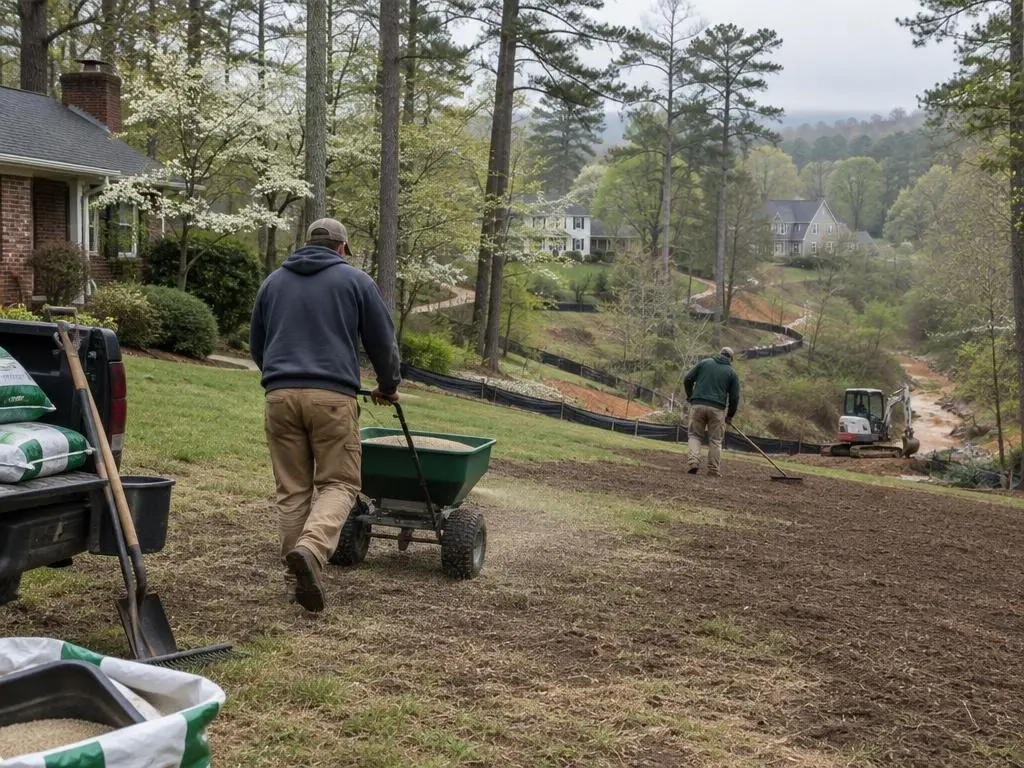
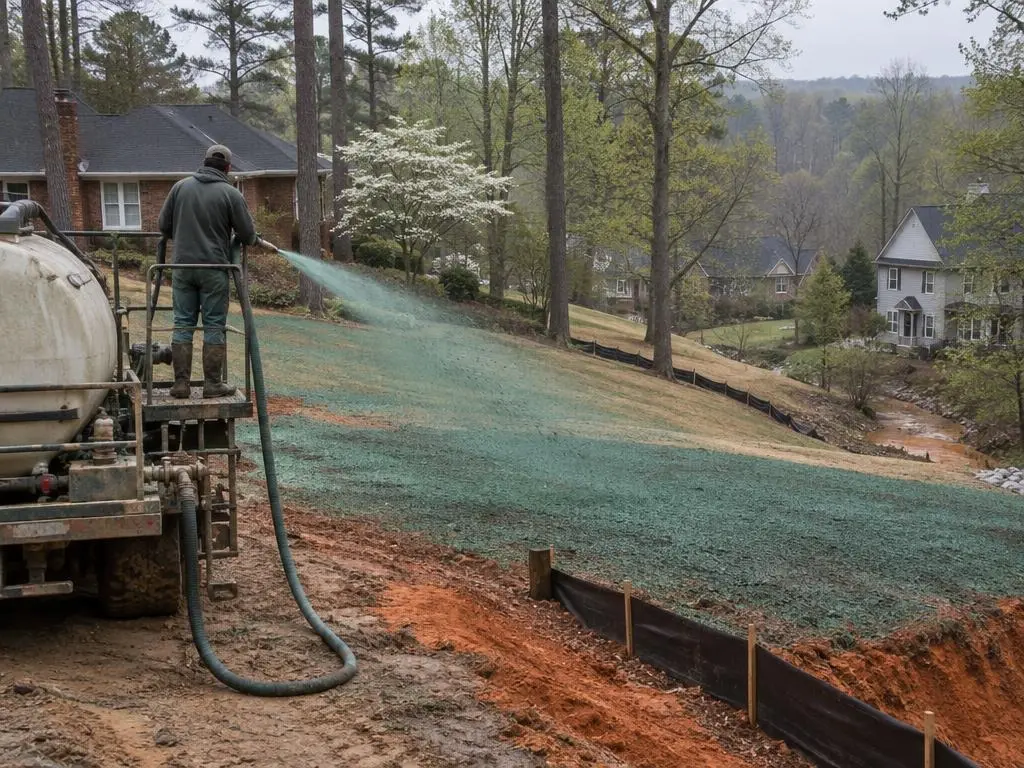
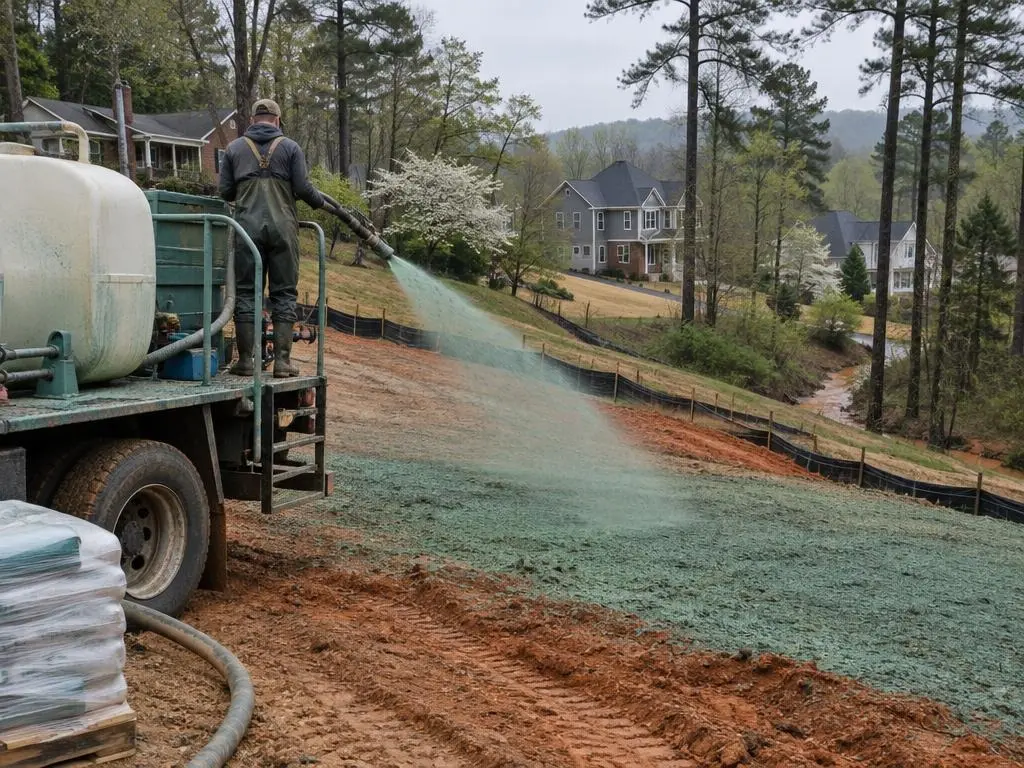
Commercial and subdivision hydroseeding in Atlanta covers the big, open areas that construction leaves behind: graded lots waiting for a house, subdivision entrances and common areas, detention pond banks, utility corridors, school and church grounds, and the edges of new parking lots. Builders, developers, site contractors and property managers call us when they need large areas seeded quickly, often to meet an erosion control plan or to close out a permit. Hydroseeding contractors can spray acres in a day from a truck-mounted tank, which is something no crew spreading straw by hand can match.
Why stabilization is not optional here
Georgia's Erosion and Sedimentation Act sets minimum best management practices for land-disturbing activity, and local issuing authorities across the metro enforce them through land disturbance permits. Among the requirements: the disturbed area and the time it stays exposed must be kept to a practicable minimum, disturbed soil must be stabilized as quickly as practicable, temporary vegetation or mulching must protect exposed critical areas during development, and permanent vegetation must go in as soon as practicable. Local rules have to be at least as strict as the state's Manual for Erosion and Sediment Control in Georgia. In plain terms, a graded site in this region cannot sit bare for months.
Turbidity and buffers
The same law treats sediment-laden runoff seriously. A discharge from a site where best management practices were not properly designed, installed and maintained counts as a separate violation for each day it raises the turbidity of receiving waters by more than 25 NTU for warm water fisheries, or 10 NTU for trout waters. There is a 25 foot buffer along the banks of state waters and a 50 foot buffer along trout streams, and no land disturbance is allowed inside them until the site is complete. With Atlanta's average of about 50 inches of rain a year, and no reliably dry month, the gap between grading and grass is when most of these problems start. Fast seeding with a proper mulch rate shortens that gap.
Temporary seed, then permanent
On phased work we often seed in two rounds. A temporary cover goes on graded areas that will sit for a season, and the permanent mix goes on once final grades are set or the planting window is right. In the metro, permanent turf mixes are usually tall fescue, which is well adapted to the Southeast's transition zone and roots deeply, or bermudagrass, which takes heat and drought and is common on sports fields and sunny commercial grounds. The season decides which one makes sense. Fescue suits late summer and fall seeding; bermudagrass suits late spring and early summer.
Working with builders and site supers
We work from your erosion, sedimentation and pollution control plan when the site has one, and we coordinate with the grading contractor so we spray soon after final grade instead of after the next storm has rutted it. On subdivision work we can seed lot by lot as homes close, or whole phases at once. Detention ponds, swales and outfalls usually need more than a lawn mix, so we price heavier mulch or erosion control blankets for those areas separately.
What it costs at scale
Consumer cost guides put large-area hydroseeding at roughly $2,000 to $4,000 an acre according to Fixr, or $2,136 to $4,897 per acre according to LawnStarter. Public bids give another reference point: in 2023, the City of North Little Rock, Arkansas received hydroseeding bids of $2,595 and $3,325 per acre for a park recovery project. Your price depends on acreage, access for the truck, water source, seed and mulch rates, and how many mobilizations the phasing requires.
Common commercial jobs
- Graded lots in new subdivisions, before or after house construction
- Entrances, common areas and amenity grounds
- Detention and retention pond banks
- Road shoulders, utility easements and pipeline corridors
- Office parks, churches, schools and industrial pads
Scope for Commercial Sites
We price each area by what it needs, from quick temporary cover to permanent turf.
Temporary stabilization seeding
Fast-growing temporary cover and mulch for graded areas that will sit before final work.
Permanent turf seeding
Tall fescue or bermudagrass mixes on final grade, timed to the season.
Lot-by-lot builder seeding
Seeding individual lots as homes are finished, scheduled with the builder.
Pond banks and swales
Heavier mulch rates or blankets on detention pond slopes and drainage channels.
Right-of-way and easements
Long, narrow utility and road shoulder areas reached by hose from the truck.
Final stabilization punch lists
Reseeding thin or washed areas so a site can be closed out.
Large-Area Hydroseeding Benchmarks
| Area or source | Published figure |
|---|---|
| Per acre, consumer guide (Fixr) | $2,000 to $4,000 |
| Per acre, consumer guide (LawnStarter) | $2,136 to $4,897 |
| One acre, residential-style job (HomeGuide) | $5,000 to $8,500 |
| Half acre (HomeAdvisor) | $1,300 to $4,400 |
| 2023 city park bid, North Little Rock, AR (two bidders) | $2,595 and $3,325 per acre |
Public bids reflect one project in one year, and guide figures are national. Acreage, access, water, mulch rate and phasing set your price. Use as a guide. Our written quote spells out the final cost.
How We Run a Site
1. Plan review
We read the erosion control plan, seed specs and phasing, and walk the site with your super.
2. Schedule to grade
We line up spraying for right after final grade, before rain can rut the surface.
3. Spray by zone
Lots, slopes and ponds each get the seed and mulch rate their area calls for.
4. Inspect and touch up
After rain events we look for thin or washed spots and reseed them.
5. Close-out
We help bring areas to the uniform cover needed for final stabilization.
Why Choose Us for Commercial & Subdivision Hydroseeding
Plan-literate
We follow your erosion, sedimentation and pollution control plan rather than improvising.
One call for seed and BMPs
Silt fence, inlet protection and blankets can be handled with the seeding.
Phasing that fits
Lot-by-lot, phase-by-phase or whole-site, scheduled around your build.
Commercial & Subdivision Hydroseeding Questions
How fast can hydroseeding companies cover a graded site?
A truck-mounted hydroseeder covers large areas in a single day, depending on tank size, water supply and access. Scheduling right after final grade matters more than spray speed, because rain on freshly graded clay creates ruts that have to be fixed first.
Do you seed to an engineer's specification?
Yes. When a site has an erosion, sedimentation and pollution control plan with seed mixes and mulch rates, we follow it. If something on the plan does not fit the season, we raise it with you before spraying.
What is the difference between temporary and permanent seeding?
Temporary seeding gives fast cover for areas that will be disturbed again or that cannot get permanent grass yet. Permanent seeding is the long-term turf, usually fescue or bermudagrass in the Atlanta area, placed on final grade.
Can you seed detention pond banks?
Yes. Pond banks usually need heavier mulch or erosion control blankets than flat lots, because water runs down them during every storm. We quote those areas separately.
Commercial & Subdivision Hydroseeding Service Areas
- Hydroseeding in Atlanta, GA
- Hydroseeding in Sandy Springs, GA
- Hydroseeding in Roswell, GA
- Hydroseeding in Alpharetta, GA
- Hydroseeding in Johns Creek, GA
- Hydroseeding in Milton, GA
- Hydroseeding in Marietta, GA
- Hydroseeding in Kennesaw, GA
- Hydroseeding in Acworth, GA
- Hydroseeding in Woodstock, GA
- Hydroseeding in Canton, GA
- Hydroseeding in Cumming, GA
- Hydroseeding in Suwanee, GA
- Hydroseeding in Buford, GA
- Hydroseeding in Lawrenceville, GA
- Hydroseeding in Snellville, GA
- Hydroseeding in Conyers, GA
- Hydroseeding in McDonough, GA
- Hydroseeding in Peachtree City, GA
- Hydroseeding in Fayetteville, GA
- Hydroseeding in Newnan, GA
- Hydroseeding in Douglasville, GA
- Hydroseeding in Dallas, GA
- Hydroseeding in Powder Springs, GA
Get a Commercial & Subdivision Hydroseeding Estimate
Send the plan set or site address and we will walk it with you.