
Metro Atlanta hydroseeding
Hydroseeding in Atlanta, GA
New lawns and stabilized slopes on Piedmont red clay, seeded for the sun and shade your yard actually gets.
- We measure on site and hand you a written quote
- Fescue or bermuda picked for how much sun your yard gets and the month we spray
- Seeding, slope cover and silt fence from one call
Seed That Holds on a Rainy Ridge
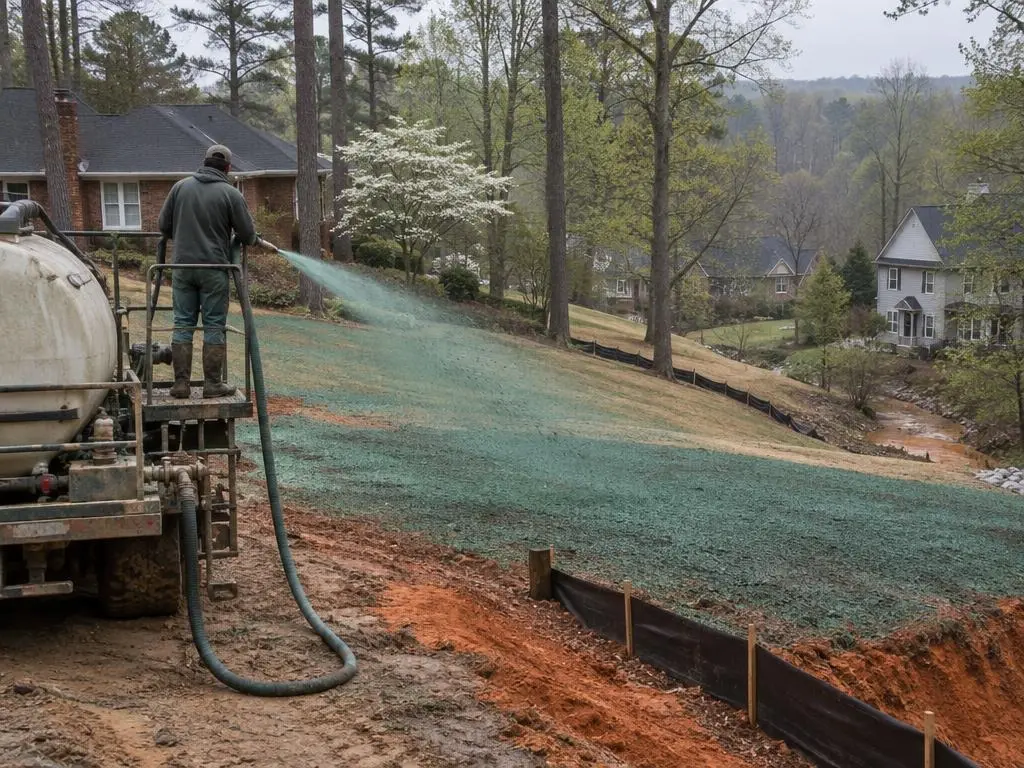
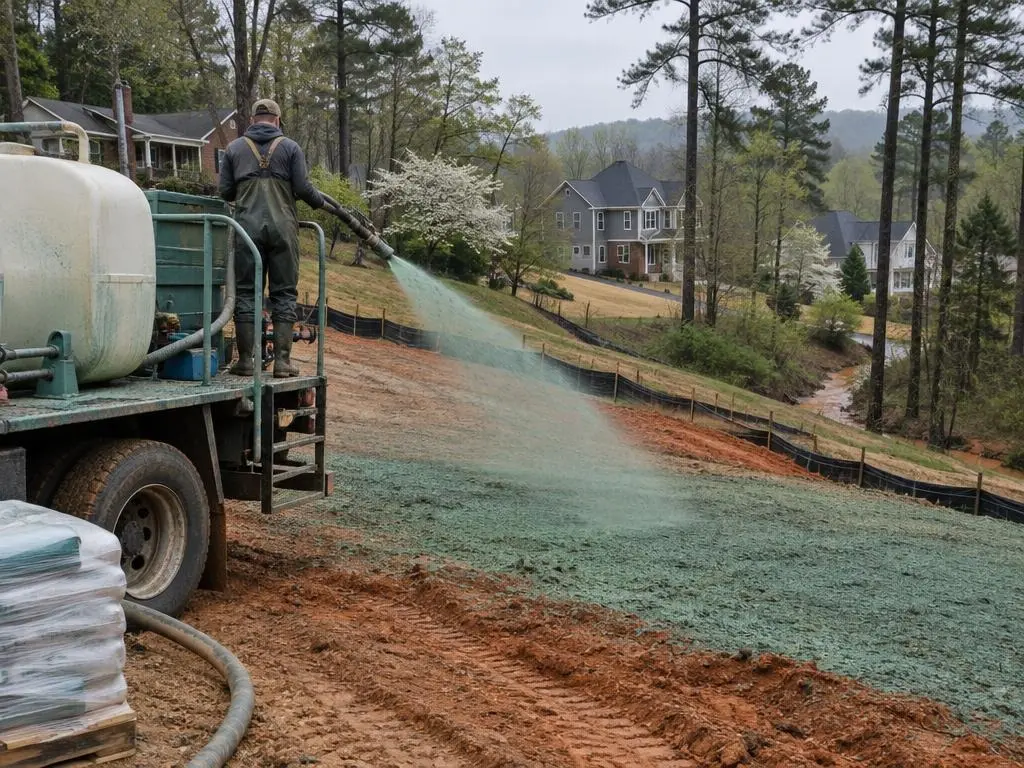
Hydroseeding in Atlanta means spraying seed, wood or paper mulch, fertilizer and a tackifier onto prepared soil in one wet pass, so the seed is pressed into the ground and covered at the same time. Atlanta grew up on a ridge south of the Chattahoochee River, about 1,050 feet above sea level, and the ground under most yards here is red clay that sheds water fast. Elite Hydroseeding Atlanta seeds new lawns, builder lots and commercial grounds, stabilizes cut slopes and drainage swales, puts up silt fence, and handles the grading and topsoil prep that has to come first. The goal on every job is the same: get living roots into bare ground before the next storm moves it.
A thin brown layer over red clay
The soil most common across the Georgia Piedmont is the Cecil series. A typical Cecil profile has 2 to 8 inches of dark yellowish brown sandy loam on top, then firm, sticky red clay that runs from about 8 inches down to 26 to 42 inches before it softens into weathered rock. That clay is dominated by kaolinite and, like other kaolinite clays, has little ability to recover once it is compacted. Much of the Piedmont was farmed hard, and erosion stripped the topsoil from many areas and left the red subsoil exposed. On a new house lot the picture is often worse, because grading and heavy equipment remove or bury what topsoil there was. Seed sprayed straight onto slick, packed clay can sprout and then die in the first dry week. We loosen packed ground, bring in topsoil where the brown layer is missing, and check acidity, since Cecil soils are naturally strongly to very strongly acid and often need lime.
Fifty inches of rain, every month of the year
Atlanta averages 50.43 inches of precipitation a year, and no month is truly dry: the wettest months bring about 4.5 to 4.8 inches and even October, the driest, averages 3.28. That is good for germination and hard on bare soil. The Eastern Continental Divide runs through the city, so some yards drain toward the Atlantic and others toward the Gulf, but on both sides water comes off roofs, drives and ridgetops quickly and carries clay with it. Georgia's Erosion and Sedimentation Act requires disturbed soil to be stabilized as quickly as practicable, calls for temporary vegetation or mulching on exposed critical areas during development, and keeps a 25 foot undisturbed buffer along the banks of state waters. A hydromulch cover with seed in it is one of the quickest ways to meet that standard on a lot or slope.
Shade from the city in a forest
Atlanta is often called the city in a forest, and with reason. Vegetation covered 47.9 percent of the city in 2017, the highest share among major American cities, and the canopy spreads out into the suburbs. A city ordinance in place since 1993 charges developers fees for removing trees. For a lawn, that means many yards spend part of the day under oaks and pines. Bermudagrass needs full sun to fill in, and dense shade near tree bases suppresses it. Tall fescue is the most heat tolerant of the major cool-season grasses, has a deeper root system than the others, and is well adapted to the transition zone that includes the Southeast. In practice, we lean toward fescue blends under trees and bermudagrass on open, sunny ground, and some properties get both in different zones.
Two grasses, two seeding seasons
Atlanta sits in USDA hardiness zone 8a, with the northern and western suburbs and parts of Midtown shading into 7b. Lows at or below freezing come about 36 nights a year. That puts the metro right in the middle, where cool-season and warm-season grasses both grow and each wants its own planting window. University of Tennessee Extension guidance puts the ideal time for cool-season grasses like fescue at late August to mid-October, and warm-season grasses at May 1 through June 30. Here, September highs average about 84 degrees and October highs about 74, which suits fescue germination. Bermudagrass starts active growth above about 59 degrees and does best from the mid-70s into the 90s, so it belongs in late spring and early summer seeding. If you call us in November wanting bermudagrass, we will usually suggest erosion cover now and the lawn in May.
Sod, hydroseed or broadcast seed
All three work here. The question is cost, speed and the ground you have.
- Sod gives you grass the day it goes down and suits small areas where you need it finished fast. HomeAdvisor puts sod at about $0.35 to $0.85 per square foot for material, and installed sod runs $1 to $4 a square foot according to HomeGuide.
- Hydroseed covers large and sloped areas for much less. HomeAdvisor's range is about $0.06 to $0.20 per square foot. University of Nebraska Extension notes hydroseeded grass is generally visible in 5 to 7 days, where dry seed takes two to three weeks to show, and the mulch holds seed and moisture on slopes where dry seed rolls off.
- Broadcast dry seed costs about $0.10 to $0.20 per square foot by HomeAdvisor's figures and is fine for thickening a thin lawn, but loose seed on bare clay tends to wash into low spots in the first hard rain.
HomeGuide puts the first mowing of a hydroseeded lawn about 4 to 6 weeks after spraying.
How a hydroseeding job runs
- We visit, measure and note sun, shade, slope and drainage
- Your quote comes in writing, with soil prep, the seed mix and any erosion control each on its own line
- Rocks, roots and debris come out, and packed clay gets loosened
- Topsoil and lime go on where the soil needs them, then a final grade that sheds water away from the house
- Silt fence or inlet protection goes in first if runoff could leave the property
- We spray the slurry, with heavier mulch or blankets on slopes and swales
- You get watering and mowing instructions, and we check in during establishment
Neighborhoods and Towns We Cover
We work inside Atlanta city limits and across the metro. North of the city we seed in Sandy Springs, Roswell, Alpharetta, Johns Creek and Milton, where wooded lots run down toward the Chattahoochee and its creeks. In Cobb and Cherokee counties we cover Marietta, Kennesaw, Acworth, Woodstock and Canton, with steep ground near Kennesaw Mountain and lots that drain toward Lake Allatoona and the Etowah River. To the northeast we work in Cumming, Suwanee, Buford and Lawrenceville, some of the fastest-growing parts of the region, where new subdivisions keep silt fence and seeding crews busy. East and south of the city we serve Snellville, Conyers, McDonough, Peachtree City and Fayetteville, and to the west and southwest Newnan, Douglasville, Dallas and Powder Springs. Granite close to the surface, old cotton fields with worn soil, lake and stream buffers, and high ridgetops all change how a lawn or slope should be seeded, and we plan each job for the ground it is on.
- Hydroseeding in Atlanta, GA
- Hydroseeding in Sandy Springs, GA
- Hydroseeding in Roswell, GA
- Hydroseeding in Alpharetta, GA
- Hydroseeding in Johns Creek, GA
- Hydroseeding in Milton, GA
- Hydroseeding in Marietta, GA
- Hydroseeding in Kennesaw, GA
- Hydroseeding in Acworth, GA
- Hydroseeding in Woodstock, GA
- Hydroseeding in Canton, GA
- Hydroseeding in Cumming, GA
- Hydroseeding in Suwanee, GA
- Hydroseeding in Buford, GA
- Hydroseeding in Lawrenceville, GA
- Hydroseeding in Snellville, GA
- Hydroseeding in Conyers, GA
- Hydroseeding in McDonough, GA
- Hydroseeding in Peachtree City, GA
- Hydroseeding in Fayetteville, GA
- Hydroseeding in Newnan, GA
- Hydroseeding in Douglasville, GA
- Hydroseeding in Dallas, GA
- Hydroseeding in Powder Springs, GA
Why Homeowners Call Elite Hydroseeding Atlanta
Clay-first prep
We loosen compacted red clay and add topsoil and lime where they are missing, because seed on packed subsoil rarely lasts its first summer.
Grass picked for your light
Fescue for shaded yards, bermudagrass for full sun, or a split plan when one lot has both.
Honest timing
If it is the wrong month for the grass you want, we say so and offer temporary cover until the window opens.
Erosion work in the same visit
Silt fence, inlet protection, blankets and slope mulch can go in alongside the seeding instead of waiting on another company.
Common Questions
Is October too late to hydroseed in Atlanta?
Not for tall fescue. University of Tennessee Extension puts the ideal cool-season window at late August to mid-October, and Atlanta's October highs average about 74 degrees. Early October is comfortable; late October gets riskier as nights cool. October is too late for bermudagrass, which we seed from about May through June.
What grass seed works in Atlanta yards?
It depends on light. Tall fescue, a cool-season grass well adapted to the Southeast's transition zone, is our usual pick for yards under Atlanta's heavy tree canopy, since bermudagrass is suppressed by dense shade. Bermudagrass is the stronger choice on open, sunny lots and takes heat and drought well, but it goes tan when dormant in winter and thins out in dense shade.
What would a 3,000 sq ft Atlanta lawn run to hydroseed?
HomeGuide lists 2,000 sq ft at $500 to $700 and 5,000 sq ft at $1,000 to $1,750, so a 3,000 sq ft lawn falls between those. HomeGuide also notes most hydroseeding companies charge a minimum per job, commonly $300 to $500 and sometimes higher. Soil prep, topsoil and slope work add to the total, and we set the price once we measure.
What are the downsides of hydroseeding?
It is not instant: grass shows in about a week and the first mow is roughly 4 to 6 weeks out. The area needs regular watering until roots are established, and a hard storm in the first days can move slurry on steep, bare clay if the mulch rate is too light. Timing matters too, since fescue and bermudagrass each have their own seeding window.
Will hydroseed grow on red clay?
Yes, if the clay is prepared. Packed clay should be loosened, topsoil added where it is missing, and lime applied when a soil test shows strong acidity, which is normal for Cecil soils. Sprayed straight onto slick, compacted clay, seed often sprouts and then fails in the first dry stretch.
Can hydroseeding stop orange runoff from a new lot?
It is a big part of the fix. Georgia's erosion law calls for disturbed soil to be stabilized as quickly as practicable and for sediment to be trapped until it is. Seed and mulch cover the soil, while silt fence and inlet protection catch what moves before the grass takes hold.
Do hydroseeding companies in Atlanta seed under trees?
We do, with a shade-tolerant fescue blend and realistic expectations. Grass needs some direct sun, so in very dense shade we may suggest limbing up trees or mulching the darkest spots instead of seeding them.
Our Services
Six services that get bare Atlanta ground covered, held in place and growing.
Residential Hydroseeding
New hydroseed lawns for homes, with clay prep and a fescue or bermudagrass mix chosen for your yard's light.
Learn more →Commercial & Subdivision Hydroseeding
Hydroseeding for builders, developers and property managers: lots, common areas, detention ponds and right-of-way.
Learn more →Clay Slope Erosion Control
Blankets, hydromulch and bonded fiber matrix for red clay cut slopes, swales and ditches that keep washing.
Learn more →Silt Fence & Perimeter Sediment Control
Silt fence, storm drain inlet protection and sediment barriers around Atlanta lots and commercial sites.
Learn more →Grading, Topsoil & Lot Prep
Yard grading, topsoil, compacted clay repair and drainage dirt work before seeding.
Learn more →Shade Lawn Repair & Overseeding
Lawn repair, renovation and overseeding for thin, shaded or worn Atlanta lawns.
Learn more →Let's Get Your Atlanta Ground Growing
We come out, measure and leave you with a written quote.